I’ve written copy for a lot of websites over the past decade. Law firms, clothing brands, software developers, manufacturers, therapists. The list goes on. But when CyberShadows approached me about their rebrand, I knew immediately this was going to be different.
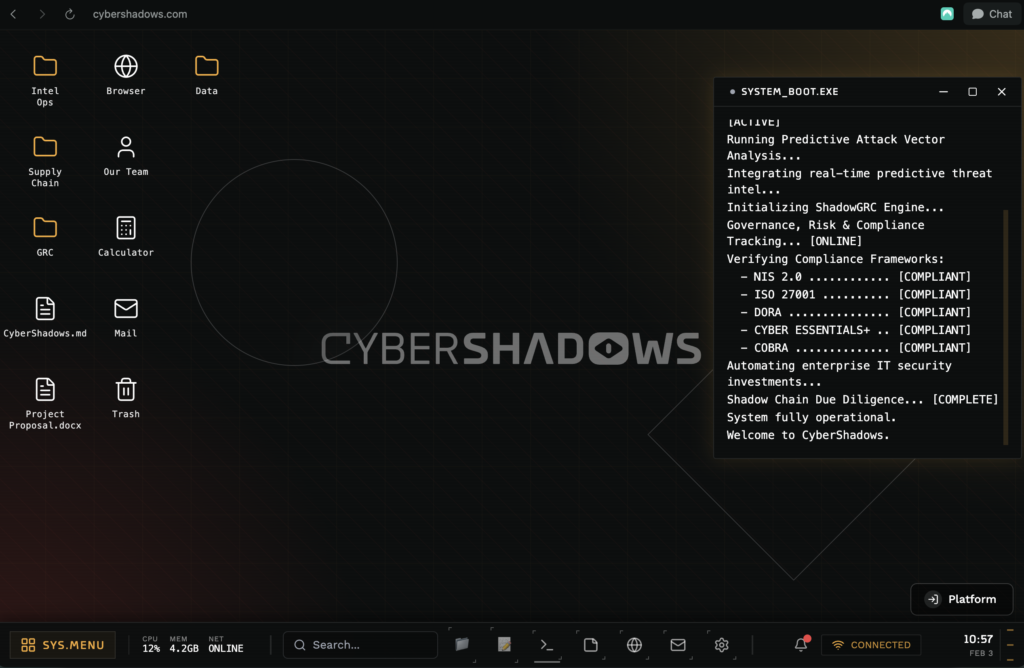
For starters, they wanted a website that was actually a desktop inside a browser. A fully interactive operating system you can poke around in, complete with folders you can open, emails you can read, settings you can change, and a trash bin you can rummage through like a digital raccoon.
Reader, I was absolutely delighted.
The New Aesthetic
The CyberShadows rebrand centres on a bold black and yellow colour scheme that makes you sit up and pay attention, which is rather the point when you’re a predictive threat intelligence company. The high-contrast black and yellow colour scheme leverages the psychology that wasps figured out millions of years ago and that humans adopted for hazard signs – looking dangerous is half the battle. CyberShadows took notes.
But my job wasn’t the visuals. My job was filling this beautiful digital playground with words worth reading and Easter eggs worth hunting for. And because the team at CyberShadows clearly understand that cybersecurity doesn’t have to be boring, they gave me permission to have fun.
Meet Oliver and Gerald
Every good workplace sitcom needs its characters, and the CyberShadows website has two recurring stars, mixed in among some real life team members.
Oliver Hughes is the Threat Intelligence Intern. On day one, he:
- Found the WiFi password on the microwave
- Clicked ‘Allow’ on approximately fifteen browser permission pop-ups (some in Russian)
- Plugged in a USB stick he found in the car park to ‘see who it belonged to’, and downloaded something called ‘totally_safe_productivity_tool.exe’ using the admin credentials helpfully written on a sticky note on his monitor.
His laptop is now overheating like it’s mining cryptocurrency. Oliver represents the very real security nightmare that walks through your office door every Monday morning with a coffee and good intentions.
Gerald Pemberton, Chief Compliance Pedant, is Oliver’s polar opposite. Gerald has:
- Conducted a formal risk assessment of the office microwave (it has buttons, which technically makes it an input device).
- He’s filed an incident report about an unregistered biscuit tin. It has cookies, you see.
- He has documentation about his documentation.
Real life Rory is counting down the days to his retirement, but the legal team advises that won’t be for another 27 years.
Together, they represent the two extremes every security team lives between: the blissfully unaware and the pathologically cautious.
Easter Eggs Worth Hunting For
The real joy of this project was hiding things for curious visitors to find. The kind of person who pokes around a website’s corners is exactly the kind of person CyberShadows wants to talk to. So we rewarded that instinct.
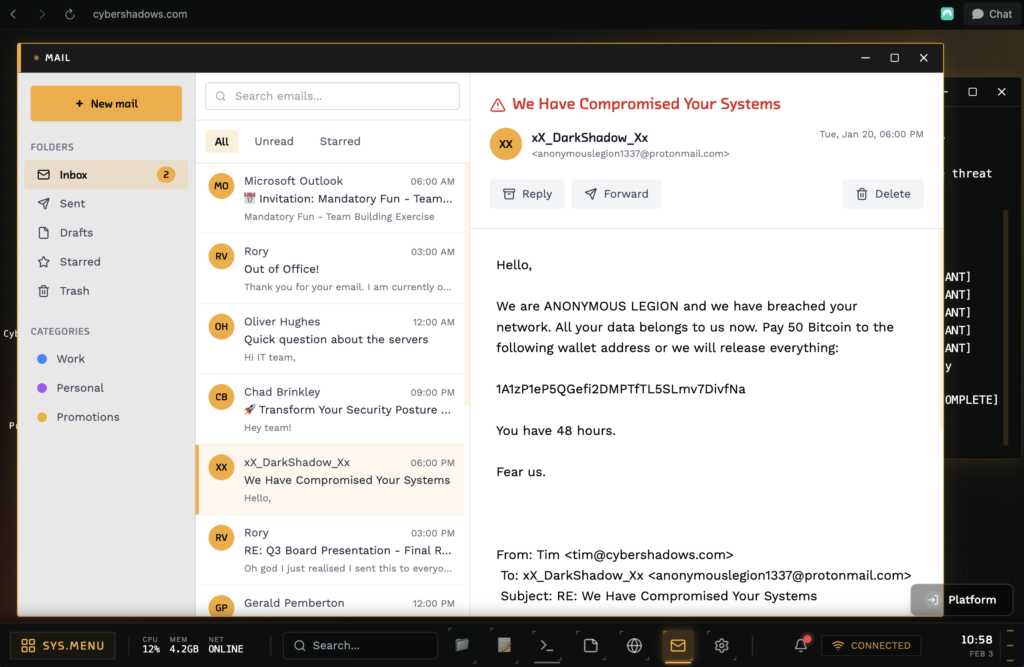
Open the inbox and you’ll find a Nigerian prince email addressed specifically to ‘Esteemed Security Professionals’. (The attached .exe file is, apparently, ‘completely safe’.) You’ll also find a sales email from a competitor trying to sell CyberShadows on… predictive threat intelligence. There’s also a reply.
The deleted emails folder contains an exchange about whether Gerald can be fired (no, he cannot – he has documented everything), an email with no body text and just an attachment called ‘scream_into_void.mp3’, and a draft whistleblower report about someone voluntarily using Internet Explorer. In 2026.
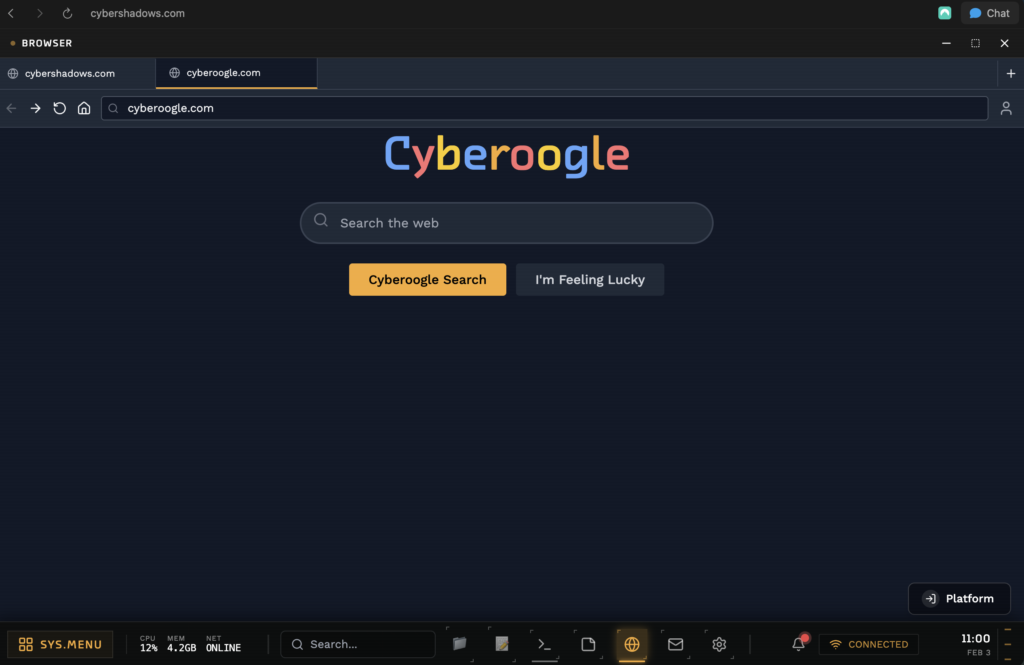
You can go into the settings and change your cursor to a little picture of Mike from sales! You can open a new tab in the internet browser and head to Cyberoogle. Click ‘I’m Feeling Lucky’ for a treat! This really is a site that rewards the curious.
The trash bin is where it really gets good. There’s a file called ‘passwords_FINAL_v3_REALLY_FINAL_use_this_one.txt’ that’s just ‘password123’ on every line. There’s Oliver’s heavily redacted incident report, where you can just about make out ‘…the fire spread to…’ and ‘…seventeen servers…’ and ‘…no longer employed.’ You can browse Gerald’s 47-tab risk assessment spreadsheet for the coffee machine, with tabs including ‘Attack Vectors’, ‘Bean Supply Chain Risk’, and ‘GDPR Implications of Milk Preference Data’.
And there’s a file called ‘really_bad_file.pdf’. Go and click on it. Try to fix its corruption and see what happens.
The Point Behind the Punchlines
None of this is just for laughs.
CyberShadows’ entire business is built on the idea that threats hide in plain sight, and that the people who look closely are the ones who find them. Making visitors dig through folders and click on suspicious files is a practical demonstration of the investigative mindset that good security requires.
The emails and deleted files are funny, yes. But they’re also uncomfortably realistic. Oliver’s security disasters happen in real offices every day. Gerald’s over-documentation is how compliance actually feels to the people drowning in it.
The website rewards the curious, the thorough, and the slightly paranoid. In other words, exactly the qualities you need to do cybersecurity well.
Why This Was My Favourite Project
I’m hoping my other client’s won’t be offended, but it turns out I do have favourites.
I’ve written website copy that explains what people do. I’ve written copy that’s high-converting, professional, and says all the right things. This was something else entirely: an opportunity to build an experience that people actually want to explore.
Most websites are brochures. CyberShadows is a game. You learn about their products by using an interface. You learn about their culture by finding the jokes they hid. You learn about their approach to security by discovering how much they thought about every tiny detail.
Writing an email thread about microwave compliance was the most fun I’ve had at work in months.
But let’s get serious
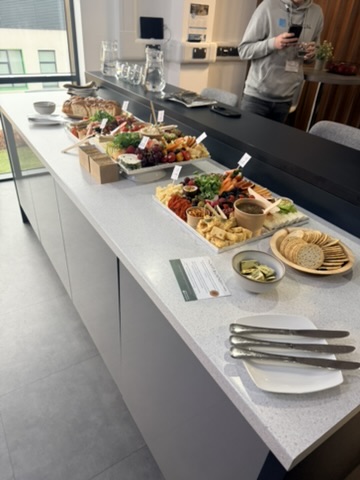
The team invited me to their launch event earlier this week to eat some lovely food and celebrate a job well done. There were a few speakers, and one of them was Graham Harrison from Lincoln College Group, speaking openly about his personal experience of a cyberattack.
I’ve spent a good few weeks researching cybersecurity and have learned that some of these attacks are a lot more insidious than I’d previously thought. These are organised hacking businesses with offices and affiliate programmes – not teenagers in hoodies.
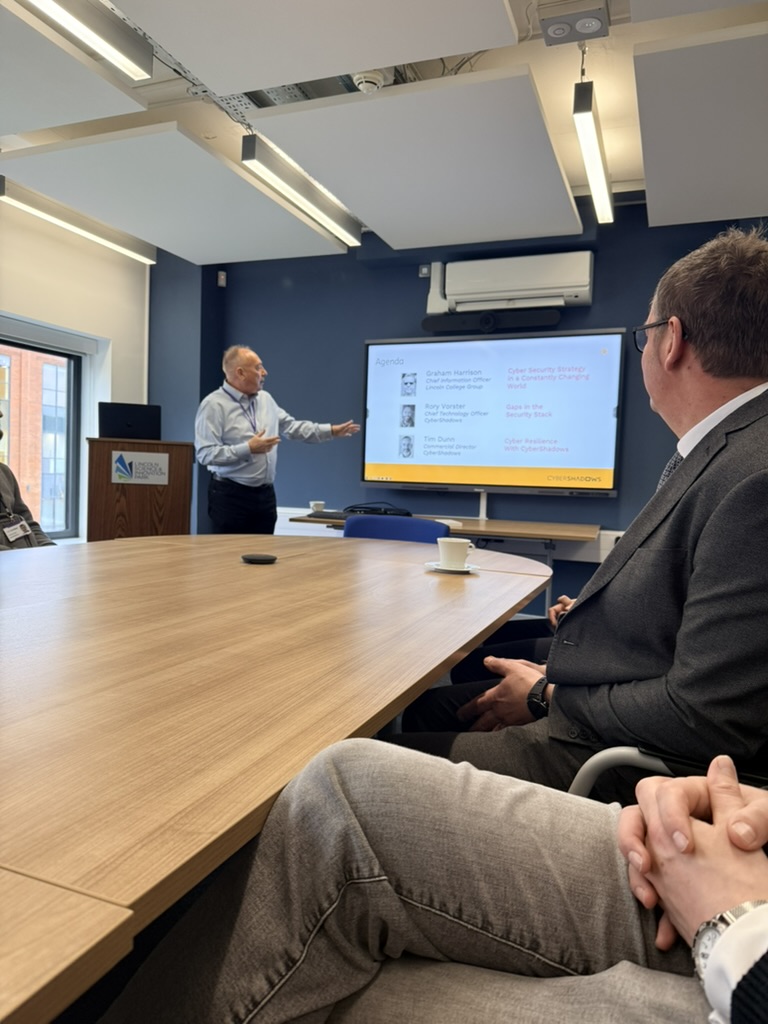
Graham’s story really demonstrated the importance of ensuring you not only have a cybersecurity firm in your corner, but that you have one that is actively looking for threats, rather than waiting for an incident and then blocking it after the fact.
I’d wholeheartedly recommend CyberShadows to any company who needs a proper line of defence against attacks. Their systems are industry-leading, and their team is made up of lovely people who genuinely care. It’s been a pleasure working with them.
Go have a poke around yourself
Head to www.cybershadows.com.
Check the trash. Read the emails. Click on things you probably shouldn’t. If you find something I hid, let me know. If you find something I didn’t hide… maybe tell CyberShadows about that one instead.