
Let me tell you about the most British telling-off I’ve ever read.
The King’s Awards for Enterprise (the poshest award a UK business can win, formerly the Queen’s Awards, now rebranded for the new monarch) recently published some guidance on using “web-based AI and editing tools” in applications.
Take a look.
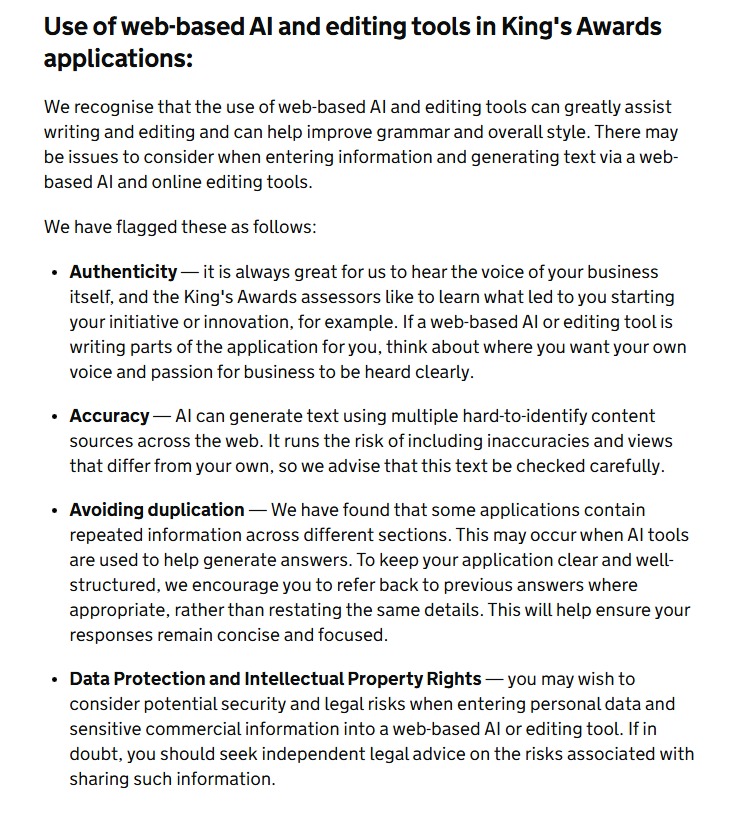
Ironically, they do use the em dash, so make of that what you will.
But, interestingly, they don’t ban AI. They’re far too polite for that. Instead, they “flag” a few things they’d like you to “consider”. Reader, when an awards body starts gently flagging things for your consideration, that is the institutional equivalent of a raised eyebrow. Allow me to translate.
What they said (and what they actually meant)
On authenticity, they wrote that “it is always great for us to hear the voice of your business itself” and that if an AI tool is “writing parts of the application for you”, you should think about where you want “your own voice and passion for business to be heard clearly.”
Translation: we can tell when it isn’t you, and it’s doing you no favours.
On accuracy, they noted that AI “can generate text using multiple hard-to-identify content sources across the web” and “runs the risk of including inaccuracies and views that differ from your own.”
Translation: your chatbot is confidently making things up, and we read these for a living.
On avoiding duplication, they observed that “some applications contain repeated information across different sections” and that “this may occur when AI tools are used.”
This one’s my favourite, because it’s the tell that gives the whole game away. AI repeats itself across sections because it has no memory of what it wrote three answers ago. Every question gets the same general padding, the same recycled value proposition, the same “we are passionate about delivering excellence” mulch. A human writer remembers section two when they’re writing section five. A language model is meeting your application for the first time, over and over again.
On data protection, they suggested you “may wish to consider potential security and legal risks” before feeding sensitive commercial information into a third-party tool. Sensible. Also slightly terrifying if you’ve been pasting your trade secrets into a free browser plug-in. But that’s a different blog post.
So is AI the villain here?
I’m not anti-AI. I use it. It’s marvellous for consolidating research, bashing out a first scaffold, or triple-checking drafts.
The King’s Awards aren’t anti-AI either. They explicitly say it “can greatly assist writing and editing.” They’re right.
The problem was never the tool. The problem is what people do with it.
Because very funder, every assessor, and yes, possibly the King himself, knows in their bones that people respond to effort. We are wired for it. We can feel the difference between something made for us and something churned out at us.
It’s why a handwritten note makes a bigger impact than a quick text. It’s why “thanks for your email” evokes a different response to a reply that actually engaged with what you said. It’s why we will happily ignore a cold-outreach LinkedIn message that looks like it’s been copied and pasted to 50 other people, but will issue a polite response if we detect the person has put in even a small modicum of effort.
An award application is, at its heart, a piece of persuasion that says we did something worth recognising, and here’s the proof. When you outsource the thinking to a chatbot and submit the bare minimum, you’re sending a message you didn’t intend to send. You’re saying: I couldn’t be bothered to make the case myself.
The person reading it knows. And they make assumptions about you based on that knowledge. “They couldn’t be bothered to write this themselves, so they’re probably a low-effort company”. “They put in the minimum effort, so they don’t deserve the award”.
They will file it in the bin. Politely. With a flagged consideration, perhaps. But in the bin all the same.

The bit where I tell you I’m rather good at this
You knew this was coming.
I write award applications that sound human because I am human. I dig into what your business did, why it mattered, and what the judges want to see, then I build the case in language that sounds like a person who’s proud of their work rather than a robot issuing a press release.
And it works. One of my clients, Global HSE, were shortlisted for two more national industry awards just this week. Two. In one week. (Everything crossed for them, by the way). And there are 2 reasons why: firstly, they do a good job; and secondly, they work with a writer who also does a good job and has taken the time to understand what’s going to made the judges sit up and pay attention.
Or, as one of my clients rather memorably put it in a testimonial: I have “a unique ability and skill set that AI can’t match.” I didn’t pay him to say that. I’d have remembered, because I’d have had to write it myself, and I’d have made it funnier.
If you want more, check out this case study about how I helped Krantz Designs attain multiple national and international awards to properly acknowledge the incredible work their team does.
The royal verdict
Use AI. Genuinely. It’s a brilliant assistant and a terrible author.
But when the stakes are an award, a grant, a contract, the thing that gets you noticed isn’t fluency. Fluency is cheap now. Everyone has fluency. What’s rare, and what judges are now desperate for, is a real voice with a personality making a real case with real effort behind it.
The King’s Awards just told you as much. Ever so politely.
If you’d rather your next application didn’t go in the bin, you know where to find me.