Getting paid late is one of the biggest challenges freelancers face in the UK. After losing a client simply for enforcing my payment terms, I’m sharing exactly what you should include in your contracts and why you need to enforce it from day one.
It Started With a LinkedIn Post
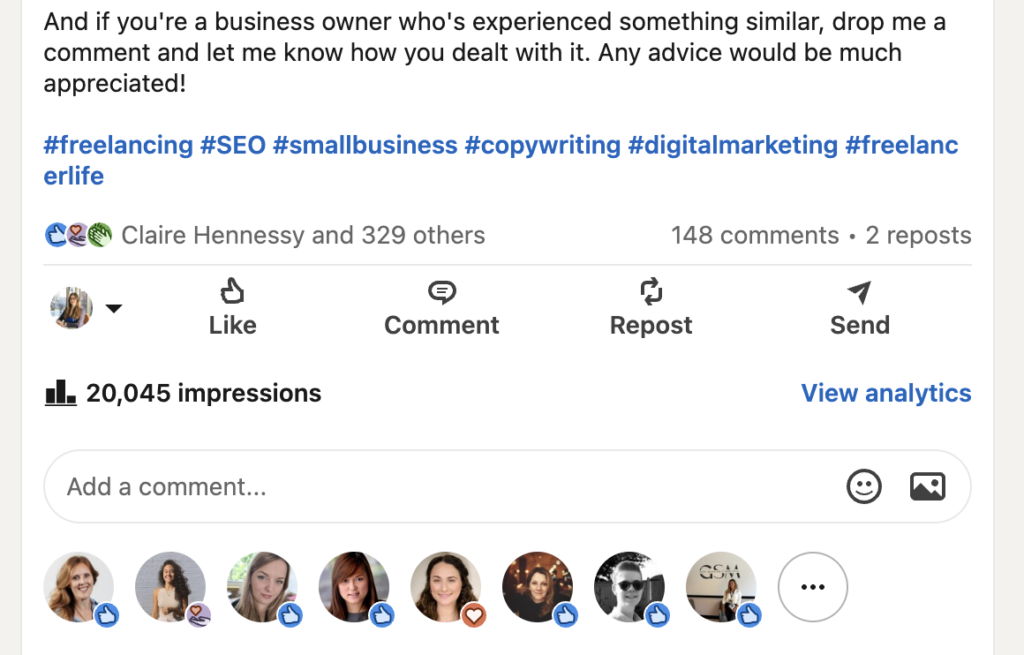
A week ago, I shared a post on LinkedIn about losing a retainer client. It wasn’t because I wasn’t delivering results or they found someone better. But because I asked them to pay me on time.
That post hit over 20,000 impressions, 330 likes, and 150 comments (and counting!). The response was overwhelming, and while I was happy to have a little boost in my impressions, I was gutted that it was because so many freelancers resonated with what I had said. Freelancers, sole traders, and small business owners flooded the comments with their own versions of exactly the same experience. Late payments, awkward chasing, and the fear of pushing back in case you lose the work entirely.
It had clearly struck a nerve because this isn’t a niche problem. It’s an industry-wide epidemic.
What Actually Happened
This particular client came to me after spending years with a large agency charging them several thousand pounds a month for SEO. When we sat down together and I explained what SEO actually involves – and what they should have been getting for that kind of money – they realised they’d spent tens of thousands of pounds on essentially nothing. Years of an un-updated website with nothing to show for it.
They moved to me for a fraction of the price. Within six months, their website was ranking number one for their primary keywords. Every blog I wrote for them ranked in the top three for their long-tail keywords. Many sat in Google’s featured snippets – the coveted position zero that most businesses would pay a fortune to achieve.
The results were exceptional. But when I reviewed my books at the end of the tax year, I noticed something: they had never once paid me on time. Every single month, I’d chased them multiple times before the money landed. I’d never charged a late fee because I was trying to be understanding – trying to maintain the relationship.
So I sent a polite message explaining that, going forward, I’d be applying the late payment fees outlined in our contract. Partly to compensate for the hours I was spending chasing invoices instead of doing billable work, but mainly to encourage them to simply pay on time.
They cancelled the contract immediately.
A client who had been ripped off by a big agency for years chose to walk away from someone delivering genuinely transformative results rather than pay their invoices when they were due.
Why This Keeps Happening
The comments on my LinkedIn post told the same story over and over again. Freelancers and small business owners bending over backwards for clients, delivering outstanding work, and then being treated as though their invoices are optional.
The root of the problem is a power imbalance. When you’re a sole trader or a small agency, every client matters. Losing one can mean a noticeable dip in income. And clients – whether consciously or not – exploit that dynamic. They know you’re unlikely to rock the boat over a late payment because you want the work.
This is especially problematic with retainer clients. With a one-off project, you can ask for 50% upfront and 50% on completion (and I do). But with a monthly retainer, the standard practice is to invoice at the start of the month with payment due by the end. You’ve no control over whether they pay on time, and chasing it up every month is exhausting, demoralising, and unpaid work in itself.
The uncomfortable truth is that enforcing your own contractual terms can cost you the client entirely. This is exactly why so many freelancers are scared to stand up for themselves. The very act of saying “please pay me what you owe me, when you owe it” is the bare minimum, but it’s treated as confrontational. And the client’s nuclear option – simply walking away – is always on the table.
Your mortgage, your electricity bill, your broadband, your software subscriptions – none of those wait because your client decided to pay you three weeks late. Your bills go out on time regardless. But somehow, freelancers are expected to absorb the cashflow hit and say nothing.
What You’re Legally Entitled to Charge for Late Payments in the UK
Under the Late Payment of Commercial Debts (Interest) Act 1998, if you’re a business supplying goods or services to another business, you have a statutory right to charge interest and compensation on late payments. You don’t even need to include it in your contract for it to apply – it’s implied by law. But you absolutely should include it anyway, because it sets expectations from the outset.
Here’s what the law allows:
Statutory interest of 8% above the Bank of England base rate, calculated from the day after the payment was due. This interest accrues daily until the invoice is paid.
Fixed compensation on top of the interest, based on the size of the debt:
- £40 for debts up to £999.99
- £70 for debts between £1,000 and £9,999.99
- £100 for debts of £10,000 or more
You can also claim reasonable costs incurred in recovering the debt – the time you spent sending chasers, making phone calls, and generally doing administrative work that isn’t what you were hired to do.
The government has signalled further reforms too. A 2025 consultation proposed making statutory interest mandatory (removing the ability for contracts to override it), capping maximum payment terms at 60 days, and expanding the powers of the Small Business Commissioner to investigate and penalise repeat offenders. These changes are expected to strengthen protections for small businesses even further.
What to Put in Your Contract: Copy-and-Paste Payment Terms
If you’re a freelancer or sole trader and your contract doesn’t already include explicit late payment terms, add them today. Feel free to copy and paste the clause I use.
Payment is due net 30 days from the date of invoice. A fixed charge of £40, £70, or £100 – depending on the size of the debt (under £1,000, under £10,000, or £10,000 and above respectively) – plus interest at 8% above the Bank of England base rate will be billed against any late payments. All intellectual property in deliverables remains with Arcanum Copy Ltd until the invoice is paid in full.
That last part matters. Until the invoice is paid, you own the intellectual property for whatever you’ve written or created. This is a powerful lever – it means the client can’t legally use the work you’ve produced until they’ve settled up.
You’re welcome to adapt this wording for your own contracts. The key elements are:
- A clear payment deadline – “net 30 days” is standard, but you can specify whatever terms suit your business.
- Explicit reference to fixed charges and interest – mirror the statutory amounts so there’s no ambiguity.
- An IP retention clause – make it clear that ownership doesn’t transfer until payment is received.
For One-Off Projects: Take a Deposit
For one-off projects, I take 50% upfront to secure the date in my diary before any work begins, and then 50% on completion. This protects you in two ways: you’re not starting work for free, and the client has already demonstrated a willingness to pay before you’ve invested your time.
Many of the comments on my LinkedIn post suggested demanding full payment upfront. That can work for smaller jobs, but for larger projects it’s not always realistic – and it can put off legitimate clients who are used to milestone-based billing. The 50/50 split is a solid middle ground.
For retainer work, upfront payment is harder to enforce. Invoicing a month in advance simply isn’t the industry standard for copywriting and most service-based freelancing. So you’re reliant on the client paying within terms – which makes having enforceable late payment clauses all the more critical.
Practice What You Preach
I’m a signatory of the Fair Payment Code and I’m Good Business Charter accredited, because I believe you can’t demand prompt payment from your clients if you’re not doing the same for your own suppliers. Every invoice I receive gets paid as quickly as possible and well within the agreed payment terms – no excuses, no delays.
The Fair Payment Code, which replaced the Prompt Payment Code in December 2024, is a UK Government-backed initiative administered by the Office of the Small Business Commissioner. It operates on a tiered award system – Bronze, Silver, and Gold – recognising businesses that pay their suppliers on time and treat them fairly.
If you’re a business owner reading this, consider signing up. It costs nothing, it strengthens your reputation, and it demonstrates a genuine commitment to fair payment practices across your supply chain. You can find it at smallbusinesscommissioner.gov.uk/fpc.
Brilliant Results Don’t Protect You
One thing that still stings about losing this particular client is that the results I delivered were outstanding. Number one rankings for primary keywords. Top three positions for every blog post. Featured snippets across multiple search terms. A complete transformation from the years of neglect they’d suffered under their previous agency (who were probably payed on time!).
And none of it mattered.
You can be exceptional at what you do. You can demonstrably transform a client’s business and generate them thousands of pounds in return on investment. And some people will still treat your invoices as an afterthought – or worse, walk away the moment you ask to be paid properly.
This is the reality of freelancing that people don’t talk about enough. Talent and results aren’t a shield against poor payment practices. The only protection you have is a solid contract, clearly communicated terms, and the willingness to enforce them – even when it’s uncomfortable.
Enforce Your Terms From Day One
If there’s one takeaway from this entire experience, it’s this: set your late payment terms in your contract and enforce them from the very first invoice. Don’t do what I did and try to be lenient for months hoping the situation will improve. It won’t.
Every month you let a late payment slide, you’re training the client to believe it’s acceptable. You’re also building up resentment and financial pressure that makes the eventual conversation even harder. And as my experience shows, by the time you do raise it, the client may have already decided that paying you on time is more trouble than finding someone else.
Start as you mean to go on. When a new client signs your contract, walk them through the payment terms. Make sure they understand the deadlines and the consequences. It’s not confrontational – it’s professional. Any client worth working with will respect that.
Want Results Like These for Your Business?
Despite losing this particular client, the work speaks for itself. Number one Google rankings, featured snippets, and a measurable increase in organic traffic and enquiries – that’s what I deliver for my copywriting and SEO clients at Arcanum Copy.
If you’re a business owner who wants to see your website climb the search rankings and actually bring in customers, I’d love to hear from you. And if you pay your invoices on time, we’ll get along brilliantly.
Join my mailing list to get practical SEO and copywriting tips straight to your inbox, or get in touch to talk about how I can help your business grow.